





2026/11/22 Back
When you hear "fine rural products," what comes to mind?
The inaugural Historical and Classic Industries Expo was held at Phase II of the Hangzhou International Expo Center from November 20 to 22. Among the booths in the six major industry exhibition areas—silk, tea, porcelain, traditional Chinese medicine, brewing and arts and crafts—"fine rural products" presented another kind of appearance. For example, at the Wensli booth, the golden cocoon "Golden Silkworm No. 1" was decorated in the shape of a bonsai. Yet few people know that some of these cocoons come from Xidong Village in Kaihua, Quzhou.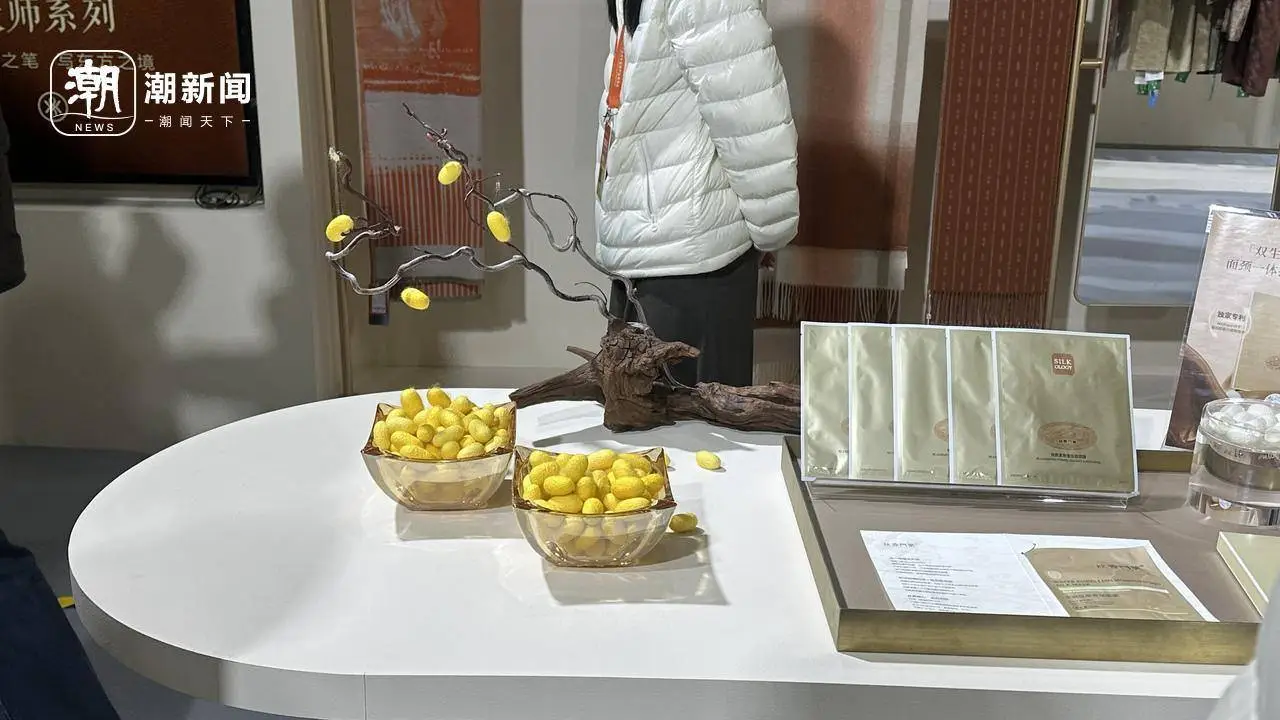
The "Golden Silkworm No. 1" cocoons at the Wensli booth
When historical and classic industries take root in rural areas, how exactly do these "fine products" grow?
Starting from breeding silkworm cocoons
to cultivating an entire industrial chain
Walking into the integrated agriculture, culture and tourism exhibition hall of Xidong Village, Huabu Town, Kaihua County, golden silkworm cocoons have been ingeniously crafted into exquisite handicrafts, attracting many tourists to stop and admire them. Why are Wensli's silkworm cocoons displayed in a rural exhibition hall?
The village's connection with Wensli began in 2018. At that time, Xu Yifeng, the village's Party branch secretary, happened to meet Tu Hongyan, Chairwoman of Wensli, at a meeting and mentioned that the village had a sizable sericulture base—Xidong Village had been planting mulberry and raising silkworms for more than 50 years, with nearly every household engaged in mulberry planting and sericulture, and almost no farmland cultivated. That year, WWNSLI was looking for breeding bases in various places, and what attracted it was precisely the sericulture scale and techniques that Xidong Village had accumulated over decades.
In 2018, cooperation between the two sides began. The model at the time was that Wensli purchased all the silkworm cocoons the village produced, however many there were. Later, Wensli suggested that farmers replace their mulberry saplings—the old varieties had low leaf yields, and after switching to the varieties recommended by the enterprise, yields rose sharply. In 2020, "Golden Silkworm No. 1," developed by Wensli and Zhejiang University, was introduced to the village for batch breeding. This naturally golden cocoon does not require post-production chemical dyeing for reeling, and its efficiency is more than 30 percent higher than that of ordinary white cocoons. At the same time, Wensli contributed part of the funding to help the village convert traditional silkworm rooms into three-dimensional breeding machine rooms. What entered the village earlier than the equipment was people. Wensli brought in experts to teach villagers hand by hand how to breed "Golden Silkworm No. 1," providing guidance throughout the entire process from incubation to rearing. In the past two years, it has also hired an experienced retired master from the former county specialty bureau, who comes to the village every silkworm season and visits every silkworm-raising household. "Later, every time he came to inspect, he said the quality of the cocoons bred here was relatively good." This year's mulberry silkworm season, the village's 60 sheets of silkworm eggs produced more than 300 kilograms of cocoons, a 25 percent increase over last year.
Changes are continuing to deepen. Around 2023, Wensli began making health products, directly taking pupae from the village to make freeze-dried powder—silk is used for fabrics, and silkworm pupae are used as raw materials, so a single cocoon is split into two products for sale. "We have expanded the industry into the life and health track." At the inaugural Historical and Classic Industries Expo, a staff member at the Wensli booth told reporters that research by the Hangzhou Institute of Medicine of the Chinese Academy of Sciences shows that golden cocoon silkworm pupae are rich in high-quality protein and various nutritional elements.
Deep cooperation with Wensli is also reshaping the industrial structure of Xidong Village. Huang Lipeng introduced that more than 60 households in the village now plant mulberry and raise silkworms, while another 30-plus households have switched to growing mulberries. Some villagers have also started businesses in the sericulture industry. At the same time, the Wensli IP empowers the cultural tourism of Xidong Village. Huang Lipeng recalled that the village began holding a mulberry festival in 2015, when there was very little foot traffic; in recent years, popularity has grown year by year, and during this year's "May Day" golden week, the village received more than 10,000 visitors. "Now every year at the mulberry festival, Wensli comes to the village to hold a special exhibition, bringing traffic to the countryside, and with rural tourism becoming more and more popular in recent years, the village has also gained fame." Huang Lipeng said that the village's cultural tourism facilities are also being improved year by year. This year, with the future countryside project, a previously idle red-brick factory dormitory in the village was converted into a homestay with 41 rooms, which opened recently; the village has also built a new integrated agriculture, culture and tourism exhibition hall, where every stage of the silkworm from egg to moth is displayed. Interested tourists can also learn from teachers in the exhibition hall and make creative products out of silkworm cocoons. On November 26, a school study tour group of more than 300 people will enter the village, the first large group the exhibition hall has received.
In Jialing, Sichuan, Wensli has adopted a different model for creating fine rural products. Nanchong, on the banks of the Jialing River, is known as the "Silk Capital." But after the market direction changed, the local silk industry gradually declined. 2026 marks the 30th anniversary of Zhejiang-Sichuan East-West cooperation. Linhai City in Taizhou is paired with Jialing District, and cooperation funds have helped Jialing build a 65,000-mu standardized mulberry garden base, while also bringing leading resources such as Alibaba and Wensli to the area. Last year, the "Silk Threads Blossom" assistance project, a collaboration between Alibaba Philanthropy and Wensli, was launched in Jialing, introducing design concepts, market consumer insights, and digital printing and production technologies to the local area, and using a digital color management system to re-transform the traditional stitches and patterns of Shu embroidery into replicable digital products. In August this year, the Jialing District government signed a strategic cooperation agreement with Wensli to jointly build an efficient supply chain, jointly develop innovative products and empower local brands.