

2025/12/17 Back
Another Zhejiang entrepreneur has celebrated its 50th birthday.
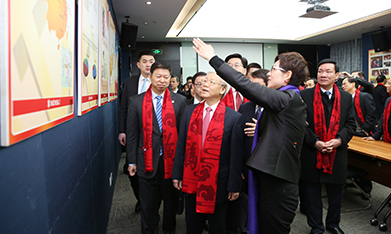
Today, more than 1,200 people gathered at the Zhejiang Provincial Great Hall of the People to attend a special ceremony—Wensli's 50th anniversary celebration.
In 1975, starting from a small commune-run factory in Jianqiao Town, Hangzhou, Wensli, founded by Shen Aiqin, along with Wanxiang founded by Lu Guanqiu and Qiujing Switch Factory (the predecessor of Chint and Delixi) founded by Nan Cunhui and others, once led the first wave of grassroots entrepreneurship among Zhejiang entrepreneurs. Wensli is also one of the few Zhejiang entrepreneurs that has weathered half a century, successfully crossed cycles, and completed second-generation succession.
Today Wensli Celebrates Its 50th Birthday
How difficult is it for a company to survive safely to 50?
How difficult is it for a company to survive safely to 50?
There was once a statistic: the average lifespan of small and medium-sized enterprises globally is 7 years, that of the top 1,000 enterprises is about 30 years, that of the Fortune 500 is about 40 years, and only 2% of companies survive more than 50 years.
Nationwide, there are not many companies that can successfully cross cycles and still maintain development across half a century, especially private enterprises. Among Zhejiang entrepreneurs, another company that recently celebrated its 50th birthday is also from the "Wan" generation—Wanxiang Group, whose two founders were only one year apart in age.
In 1969, Lu Guanqiu, in Ningwei Town, Xiaoshan, Zhejiang, led 6 farmers and raised 4,000 yuan to establish the "Ningwei Commune Agricultural Machinery Repair and Fitting Factory." At first, it mainly produced simple farm tools such as sickles, hoes, and plowshares, so that the villagers and he himself could "survive."
In the sixth year after Lu Guanqiu founded the Ningwei Commune Agricultural Machinery Repair and Fitting Factory, Shen Aiqin, one year younger than him, took over a township silk factory on the verge of bankruptcy in Jianqiao Town, Hangzhou. At that time, the factory had only two dilapidated single-story houses, a dozen primitive iron-wood looms, and 22 farmers who had just washed their feet and come ashore. Shen Aiqin's idea was simple: to let farmers receive wages like city people.
From initially carrying products on their backs while traveling far and wide, to Shen Aiqin's bold move in the 1990s to recruit the first batch of university students and send them abroad for further study, and to introduce a complete set of imported textile equipment from Italy and elsewhere; from restructuring in 2000; to the 2008 Beijing Olympics prompting Wensli's transformation from traditional manufacturing to cultural creation; from the 2016 G20 Hangzhou Summit giving rise to the new "silk + X" model; to its 2021 A-share listing making it "China's first listed silk cultural and creative company"—this silk enterprise that grew up alongside many Hangzhou residents has step by step become a nationally known leading silk culture company. In 2024, it achieved the No. 1 national silk sales volume.
Over 50 years, Wensli's various industrial segments have accumulated total sales exceeding 200 billion yuan, generated profits and taxes exceeding 8 billion yuan, provided nearly 50,000 jobs for society, and made cumulative charitable donations exceeding 100 million yuan. Among Wensli's employees, many are dual-income couples, and some even have all three family members working at Wensli.
In the next 50 years, what will Wensli rely on to once again cross cycles and achieve sustainable development?
"Closely revolve around silkworms, mulberry, silk, and satin, and jump out of silk to do silk." At today's 50th anniversary celebration, Li Jianhua delivered a speech titled "Breaking Out of the Cocoon" with holographic projection and a digital human, announcing that Wensli Silk would lay out four hundred-billion-yuan industrial sectors: the classic silk industry, textile printing and dyeing all-in-one machines, the silk big health industry, and the Wensli AI intelligent agent.
Li Jianhua also demonstrated placing an order with the Wensli intelligent agent by voice.
Li Jianhua: "Hello, today is Wensli's 50th anniversary celebration. Please design a silk scarf for Wensli's 50th anniversary."
Wensli AI intelligent agent: "Okay, please wait a moment. I will immediately design a customized silk scarf for Wensli's 50th anniversary celebration. I have called upon a database of over 700,000 patterns, completed 10 to the 27th power silk scarf designs and intelligent screening, and selected 50 of them for you to choose your preferred style."
Li Jianhua: "I choose the red one, the third from the left in the middle."
Wensli AI intelligent agent: "Okay, the design has been confirmed. Please choose facial recognition payment."
A few minutes later, the Wensli AI intelligent agent prompted by voice: "Your silk scarf has been completed. Please check it."
The entire chain—from voice ordering to design, material selection, production scheduling, and delivery—is intelligent, with rapid delivery of a silk scarf completed in 5 minutes.
Observe for Three Years, Help for Three Years, Support for Three Years
One of the Most Successful Zhejiang Entrepreneurs in Second-Generation Succession
In January 2012, a small ceremony was held at a hotel in Liangzhu. Witnessed by Zheng Mingzhi, former vice chairman of the Zhejiang Federation of Industry and Commerce and vice president of the Zhejiang Entrepreneurs Development Research Institute, 67-year-old Shen Aiqin formally handed Wensli over to her daughter Tu Hongyan.
For this moment, Shen Aiqin spent nearly 10 years training Tu Hongyan. Tu Hongyan recalled that her mother's approach was to observe for three years, help for three years, support for three years, and only then confidently hand it over to her.
In recent years, second-generation succession has become one of the most closely watched topics among Zhejiang entrepreneurs, and Wensli is also one of the most successful Zhejiang entrepreneurs in terms of inheritance.
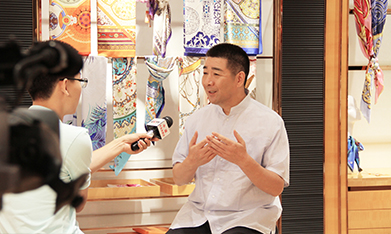
In the more than ten years since taking over Wensli from her mother, Tu Hongyan has stepped into many pits but also done many things right. In a recent exclusive interview, Tu Hongyan recalled the years since she and her husband, Li Jianhua, Chairman of Hangzhou Wensli Silk Culture Co., Ltd., took over, and summed it up as: the couple has a high degree of strategic alignment, clear division of labor, and together they subtract for Wensli.
Under the careful management of her mother Shen Aiqin, Wensli grew step by step from a small commune-run factory into a large, comprehensive, diversified traditional manufacturing enterprise with a complete industrial chain. However, today Wensli has transformed into a modern brand enterprise focused on silk as its main business while pursuing diversified development, and successfully listed on the ChiNext board in 2021, entering the capital market.
During this period, Wensli underwent two important transformations and upgrades. "Firmly grasping the soul and main business of Wensli Silk, letting everyone know that Wensli is a national gift, and gaining recognition from consumers and the market," Tu Hongyan said.
For example, Wensli previously focused on export sales. In order to make the Wensli brand bigger and stronger domestically, an important task after Tu Hongyan took over was to reach a strategic cooperation in 2013 with the century-old French silk company MARC ROZIER, which had provided design and production services for silk products of more than 40 international luxury brands worldwide.
"Transitioning from export to domestic sales, what was lacking was operational capability and awareness of the brand," Tu Hongyan said. Through the strategic cooperation with MARC ROZIER, Wensli successfully completed the building of brand operational capability and its understanding of brand value. In this process, it also completed the digitization of all patterns from 100 years of European history, and provided an important data source for Wensli's later large model to complete a database of over 700,000 patterns and more than 300 AI image algorithms.
"The Earlier the Succession, the Better"
Tu Hongyan Talks About Third-Generation Succession for the First Time
"The earlier the succession, the better." When talking about the topic of third-generation succession, Tu Hongyan told a Chengshi Interactive reporter that her daughter, who grew up in a silk family, is already prepared for the handover.
Last year, Li Jianhua and Tu Hongyan's daughter graduated from Cornell University in the United States with a bachelor's degree in Design and Fashion, and is currently pursuing a graduate degree in Global Management. At the start of today's 50th anniversary celebration, this post-00s generation made her first appearance via video, telling the silk dream of three generations from the perspective of the post-00s generation.
Speaking of her daughter, Tu Hongyan said her daughter is highly adaptable. "Her grandmother made silk, and her parents also make silk. She has been influenced since childhood, so she has an innate understanding of this industry and of aesthetics, and she is also quite eager to learn."
In Tu Hongyan's view, inheritance is the only and best way out for Zhejiang entrepreneurs. "Running a business is a marathon; don't think about getting rich overnight." As someone who has been through it, Tu Hongyan recalled her own succession process and summarized three experiences: first, attitude determines everything. "The second generation must have a grateful heart and face squarely the fact that the path walked by the older generation was not easy. As a second generation, one must have this mindset."
Tu Hongyan said that next comes professional level and diligence, as well as the qualities and abilities of an entrepreneur. "Entrepreneurs are enlarged by grievances; this is the mindset and breadth of vision of an entrepreneur."
As an outstanding representative of Zhejiang entrepreneurs, what is the most valuable wealth Shen Aiqin left to Tu Hongyan? Tu Hongyan said that compared with the wealth, people, and materials her mother left behind, the most precious things are the creed of "Six Never Forgets in Life," her style of conducting herself in society, and her spirit of never giving up until the goal is achieved. Shen Aiqin's most frequently repeated saying was "There are always more solutions than difficulties," and she taught her that "a drop of kindness should be repaid with a spring."